

Mosaic Foundation Holds 5th Cambridge Afghanistan Series Conference: “From Vision to Reality: The Roadmaps to Inclusion in Afghanistan”


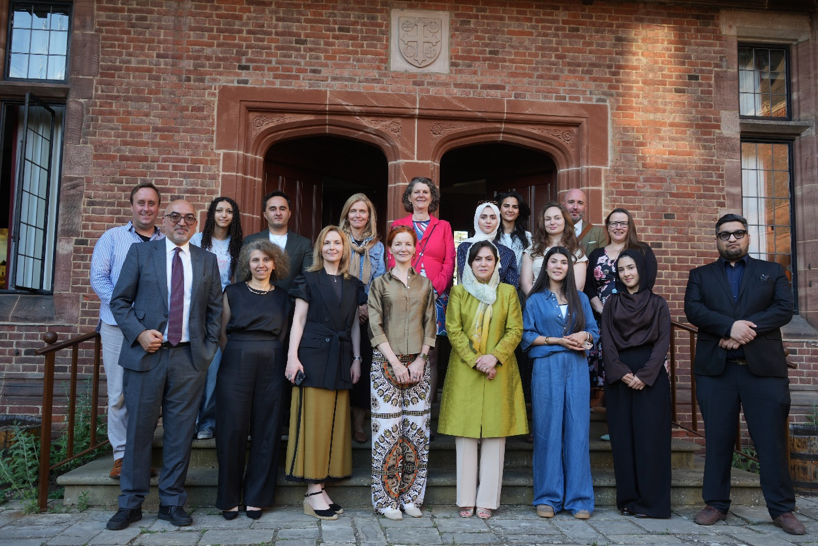
The coalescence of Afghanistan’s democratic opposition continued at the fifth round of the Cambridge Afghanistan Series, entitled From Vision to Reality: Roadmaps for Inclusivity in Afghanistan and convened by Mosaic Global Foundation on 4-5 September 2026 at Jesus College, Cambridge.
Last year’s conference saw the launch of the Comprehensive Composite Roadmap (CCR), which synthesised 21 proposals from political actors, civil society organisations and resistance groups, with 90% overlap across core concepts. The energetic conversations of CAS-IV-2025 began to build consensus around the remaining 10% of issues. The task remaining for CAS-V-2026 was to start to shape the CCR into a practical political and diplomatic process, i.e. to begin moving ‘from vision to reality’.
In his opening address, Prof Sayed Hussain Eshraq defined the long-term goal of this task as “a new political order: an Afghanistan where no child is denied a future because of hunger; where no woman or girl is excluded because of her gender; where no citizen is stripped of equal rights because of their identity; and where political power ceases to be an instrument of domination and instead becomes a vehicle for realising freedom, human dignity, and a life free from fear.”
Sir Laurie Bristow, former UK Ambassador to Afghanistan and President of Hughes Hall, then gave a keynote speech full of substantial strategic advice. He urged a “frank and honest assessment” of Afghanistan’s political reality and international context, including a robust answer to the question of engagement with the Taliban.
Next, Oxford professor Zuzanna Olszewska recounted the CCR drafting process, outlined areas of disagreement and linked the document’s success to the resolution of those disagreements.

The participants of Panel 1 also came to this conclusion, rather emphatically. Rahmatullah Yarmal, former Governor of Zabul and Laghman Provinces, put it memorably, warning that the unresolved 10% of the CCR could easily become 20%, then 30%, and then the whole project could disintegrate.
Panel 2 recommended that the CCR expand to cover a range of currently omitted topics, including transitional justice, children’s rights, the need for a socially responsible market economy, and the role of armed groups as both security providers and social factors during the transition.
Ambassador Nasir Ahmad Andisha opened Panel 3 with a positive appraisal of the convergence between the Antalya process he leads and the CCR around three key features of a future Afghanistan: constitutionalism, domestic enforcement of universal human rights values and sovereign membership of the international community. He also presented a reconciliatory reconception of transitional justice developed by the Centre for Dialogue and Progress - Geneva (CDP-G). This will assist the mission of the forthcoming UN Independent Investigative Mechanism Afghanistan (IIMA). The remainder of the panel explored how the complementary efforts of civil society and political groups could maximise the opposition’s traction with the realities of a future transition.
In a special session on gender apartheid, South African High Commissioner Kingsley Mamabolo reaffirmed his country’s unequivocal support for the struggle for human and women’s rights in Afghanistan, and even expressed qualified optimism regarding South Africa’s current hesitancy to endorse the loaded term ‘apartheid’ in this context. Dr Benafsha Yaqoobi followed this up with an appeal for intersectionality in analysing gender apartheid and victim-centred justice in addressing its aftermath.
Another keynote brimming with strategic value came from Pittsburgh Professor Jennifer Murtazashvili, who defined Mosaic’s work, including the CCR, as a “pluralist movement” for Afghanistan and the wider region. She argued for alignment - in a future Afghanistan - on a core set of political terms, within which a plurality of political ends could coexist and indeed be realised through polycentric decision making.
Richard Bennett, UN Special Rapporteur on Afghanistan, supplemented her vision by proposing human rights as an indispensable part of those core political terms, not a secondary project. He also outlined five verifiable human rights benchmarks for assessing the situation in Afghanistan, and endorsed an “all-tools” accountability approach involving the ICC, the ICJ, the new investigative mechanism developed in Geneva and legal efforts to codify gender apartheid.
Panel 4 called for improved coordination and a clearer division of labour between different opposition platforms in order to present a cohesive front in the context of a recalcitrant Taliban and a distracted international community.
Panel 5 echoed this disappointment with the international response to Afghanistan’s crisis and offered some potential counter-responses, including working with the Security Council and SRSG to ensure the political process (rather than only humanitarian aid) becomes a focus of UNAMA.
Panel 6 exposed numerous geopolitical intricacies of the situation. On the one hand, a lack of regional enthusiasm for - and international recognition of - the Taliban presents an opportunity for the opposition to begin to assert legitimacy. On the other hand, a history of Western betrayal coupled with Pakistan’s current priority of behaviour change (not regime change) dampens expectations. The Taliban’s diplomatic efforts are focused almost entirely on non-Western countries, towards which the opposition should therefore direct more attention in response. As for talking with the Taliban directly, the group’s heavily autocratic structure obstructs engagement at virtually any level.
In Panel 7, an exciting sense of consensus emerged: General Khodaidad endorsed the CCR; Ali Nazary of the National Resistance Front (NRF) and Daoud Naji of the Afghanistan Freedom Front (AFF) backed the various roadmap efforts as complementary; Governor Yarmal encouraged haste in convergence; Dr Abbas Basir of the National Assembly for the Salvation of Afghanistan urged inter-platform consultation; his colleague Maryam Parwani recommended a standing platform to retain momentum between conferences and Mazaher Rais Zade of the Citizens’ Party of Afghanistan endorsed the Political Convergence Framework (PCF) and secretariat proposed by the CCR.
An enriching break from the conference’s intense discussions was the cultural evening at King’s College, courtesy of Dr Gillian Tett, Provost. Risha (Roots) gave a magnificent musical performance, Rebecca Mitchell gave an exceptional dance display, and poetry readings touched the hearts of all present. The evening was a beautiful reminder of what we are fighting for.

Towards the end of the second day of the conference, Prof Michael Semple hosted the signing of the Cambridge Declaration, which upholds the following core principles:
1. Freedom, Equality and Human Dignity
2. Equal Citizenship and National Representation
3. Unity Through Diversity
4. Constitutional Legitimacy and the Rule of Law
5. Popular Sovereignty and National Independence
6. Peace, Security and Development
7. Democratic Cooperation and Convergence
8. Practical Action and Shared Responsibility
The Declaration is published in English, Farsi and Pashto here: https://www.mosaicfoundation.global/
Alongside the Declaration, the conference gave Mosaic the mandate to build the PCF and secretariat. This, however, will be a deeply collaborative and inclusive process. As Prof Eshraq put it in his closing address, “the political future cannot be drawn only for the people; it must be built with the people.” There is still much work to do, but vision edges ever closer to reality.


Comments